
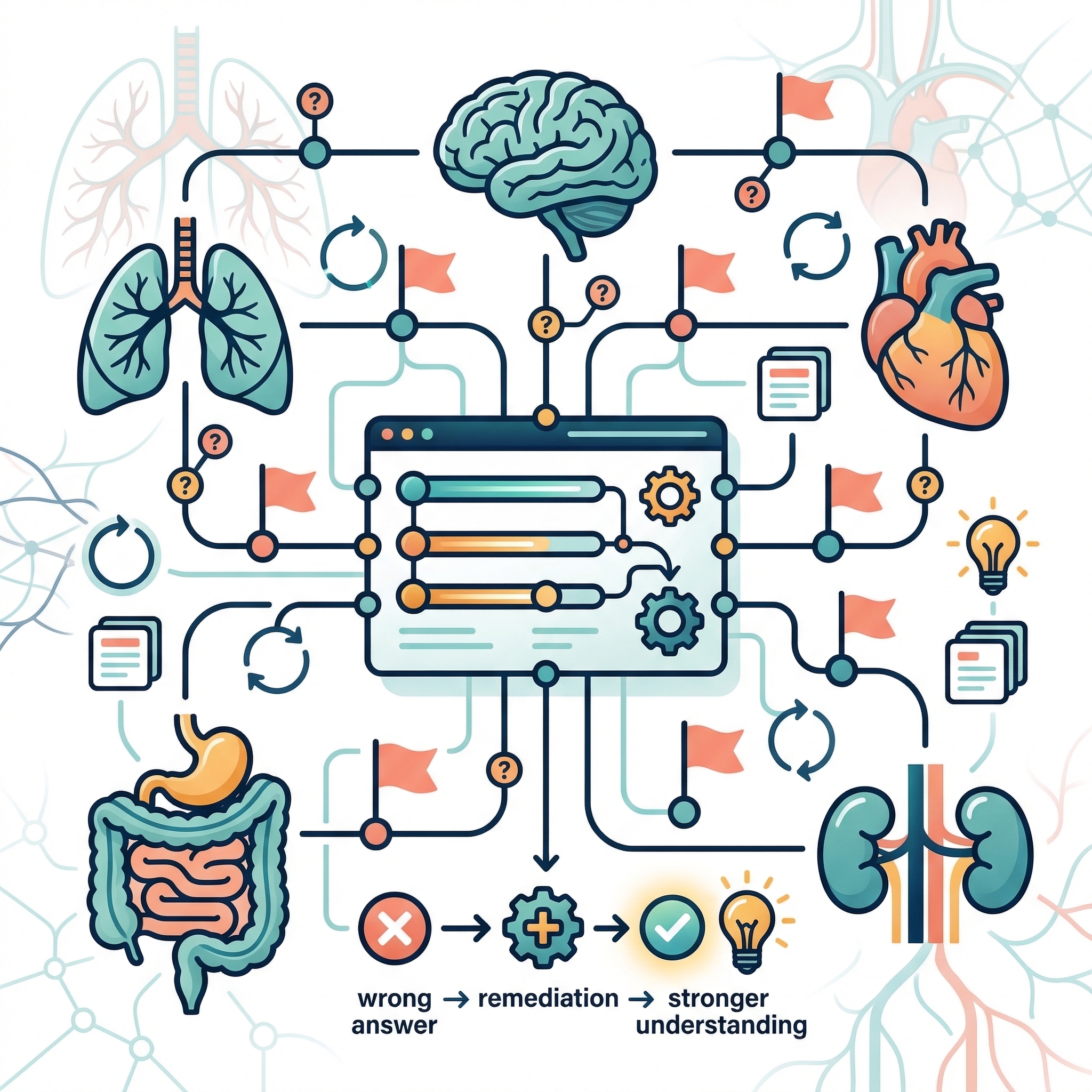
What High-Scoring Students Do Differently After Missing a Question
Most students react to a wrong answer emotionally first. They feel frustrated, embarrassed, or anxious. That response is understandable, but it is not the response that produces the fastest improvement. High-scoring students treat a missed question like diagnostic data. They want to know exactly what reasoning step broke down.
Was the problem a true knowledge gap? Did they miss a baseline clue? Did they fail to prioritize the dangerous finding? Did they understand the content but read the question in the wrong order? Those questions are much more useful than simply saying, "I got it wrong again."
Why wrong answers are more valuable than students realize
A wrong answer points directly at the place where the current learning system failed. It tells you what the next study move should be. That is why some students improve quickly with fewer questions than others. They are not just collecting scores. They are extracting signals.
A student who misses 20 questions and studies the patterns behind them may improve more than a student who rushes through 100 questions and never analyzes why the wrong option felt tempting.
The difference between random review and targeted review
Random review sounds productive, but it often wastes energy. Targeted review is different. It starts with the reason for the miss. If the student keeps missing expected versus unexpected cues, then that skill needs repair. If the learner is overconfident and wrong in pharmacology, that misconception needs correction. If the student sees the cues but chooses a delayed action, prioritization needs work.
Once the weakness is named, remediation becomes much more efficient.
Why this changes confidence too
Students often think confidence comes from getting more questions right in a row. Real confidence comes from knowing why an answer is right and why a wrong answer is wrong. That is why remediation-first systems build deeper confidence than score-only systems. They create trust in the learner's reasoning process, not just temporary relief after a lucky guess.
That kind of confidence holds up better on the exam.
How the platform applies this
NursingAcademics uses adaptive remediation instead of treating wrong answers as disposable. The point is not just to mark a miss. The point is to identify the reasoning gap and repair it before the learner moves on.
See adaptive remediation in action