
Why Body Systems Feel Disconnected Until You Learn the Shared Pattern
Students often move from one body system to another and feel like they are starting over every week. Cardiac sounds like one language. Pulmonary sounds like another. Renal brings its own rules. Neuro feels like something else entirely. That experience makes the curriculum feel heavy because the learner has no reliable bridge across systems.
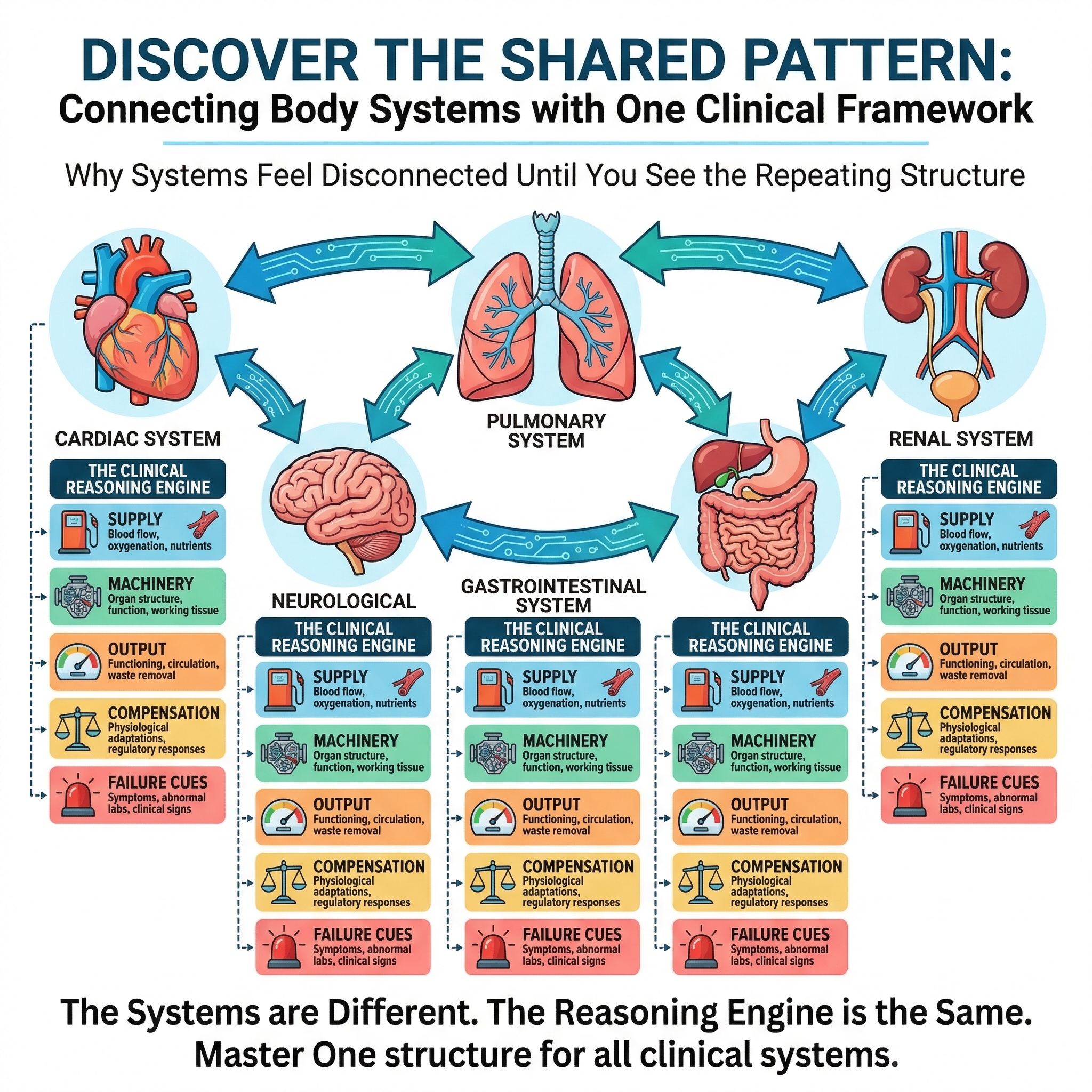
The bridge exists. It is the shared pattern beneath them: inputs, machinery, output, compensation, and patient cues.
Why the systems feel disconnected in the first place
Most systems are taught by surface content first. Students learn symptoms, disease names, and medication lists, but not the repeating logic underneath them. So the heart becomes "cardiac facts," the kidneys become "renal facts," and the lungs become "pulmonary facts." The student never gets told that these are all versions of the same deeper clinical story.
Once the learner sees the shared pattern, the systems start to feel like chapters in one book rather than separate books stacked together.
What the shared pattern looks like
What supply problem is present? What machinery or process is failing? What output is dropping? How is the body trying to compensate? Which patient cues appear next? Those questions work in cardiac topics, pulmonary topics, endocrine topics, renal topics, and more. They are not a shortcut around the content. They are the structure that makes the content usable.
This is why some students suddenly improve when they stop studying "systems" as separate islands and start tracing mechanism to cue instead.
Why this matters for exam readiness
On the exam, cases rarely announce themselves in the neat categories students expect. A patient can have respiratory distress, altered mental status, and circulatory compromise at once. If the learner only knows isolated chapter facts, they get overwhelmed. If they know the shared pattern, they can still sort what matters first.
That is why systems teaching must lead into clinical judgment, not away from it.
How NursingAcademics uses this
The systems pathways are built around one repeating framework so students can carry a stable reasoning method from topic to topic instead of rebuilding themselves every week.
Open the systems pathways