
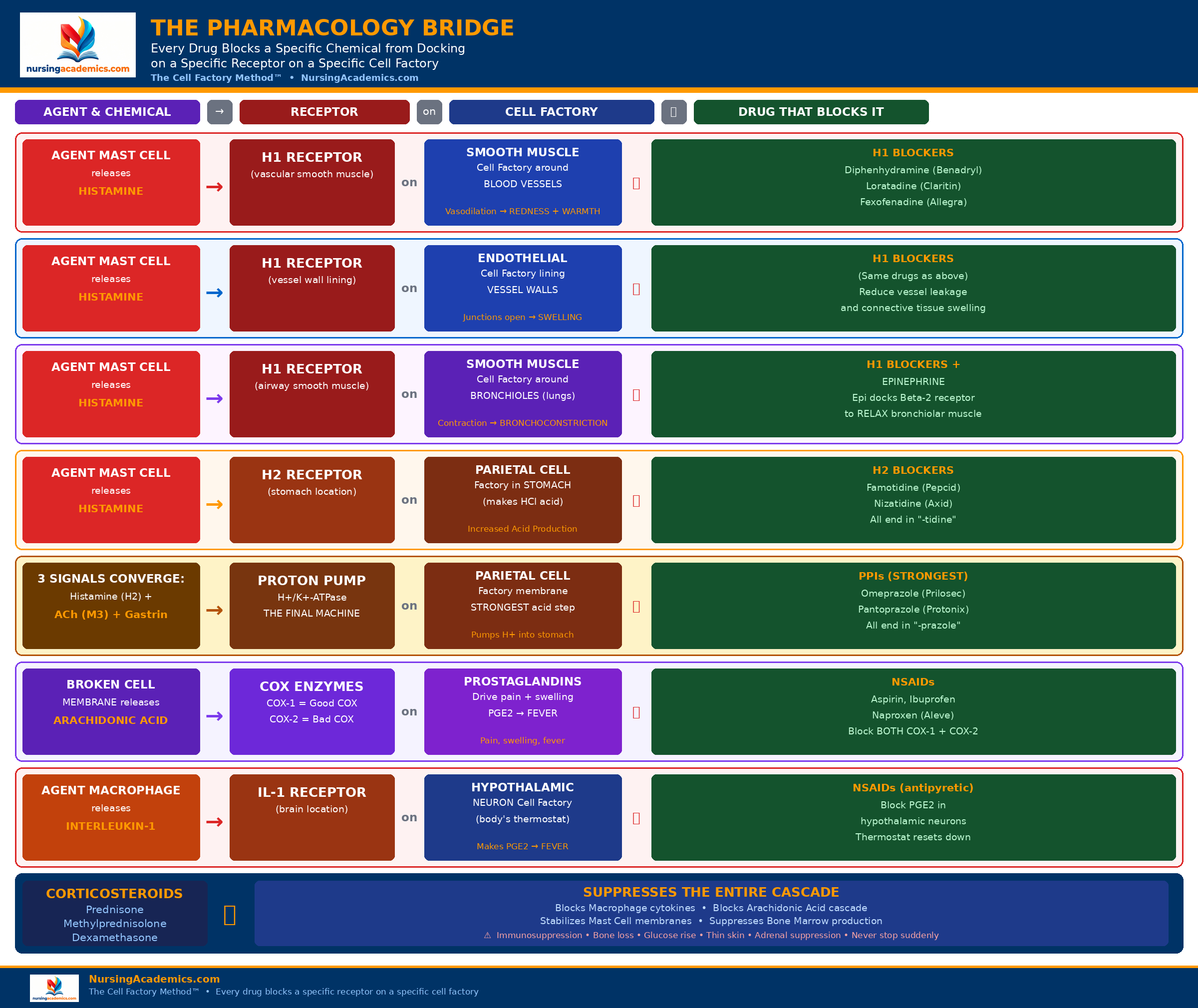
Why Students Get Pharmacology Wrong Even When They Memorized the Drug
Students often study medications as isolated flashcards: name, class, side effect, maybe a hold parameter. That can help at the beginning, but it breaks down quickly on exam questions. The question is rarely just "What does this drug do?" It is usually asking what imbalance the medication is trying to correct, what response shows it is working, and what sign shows it may now be pushing the patient too far in the other direction.
That is why memorization alone is not enough. Pharmacology becomes usable only when it is connected back to physiology and baseline.
The missing question students are not asking
Before the medication was given, what problem was moving the patient away from homeostasis? That question changes everything. A diuretic is not just "a medication that makes the patient pee." It is part of a correction strategy. A bronchodilator is not just "for wheezing." It is restoring airflow and improving downstream oxygen delivery. Insulin is not just "to lower glucose." It is helping move the patient back toward a safer internal environment.
Once the learner sees the purpose of the medication within the clinical problem, the drug stops feeling random.
Why side effects make more sense in this framework
Every medication that pushes the patient toward baseline also creates a risk of overshooting, interacting, or causing new imbalance. That is why adverse effects become easier to remember when they are tied to the same physiologic direction. A blood pressure medication that lowers pressure too far may reduce perfusion. A diuretic that removes fluid may also shift potassium. A sedating medication may protect one problem while worsening respiratory safety in the wrong patient.
Students remember this better when they ask what the medication is trying to fix, and what new danger might appear if the correction goes too far.
How this improves medication questions on the exam
On NCLEX-style questions, the strongest answer is often the one that shows the learner understands the before-and-after picture. What is the patient's baseline? What problem is present now? What effect should the nurse monitor for? What cue suggests a hold, caution, or report? That sequence is much safer than guessing from the medication name alone.
This is also why pharmacology should never be separated completely from systems and clinical judgment. Medications do not exist outside the patient story.
How NursingAcademics handles pharmacology
The program teaches medications as return-to-baseline tools tied to perfusion, physiology, and patient cues. That makes medication decisions much easier to reason through under pressure.
Open the pharmacology bridge