
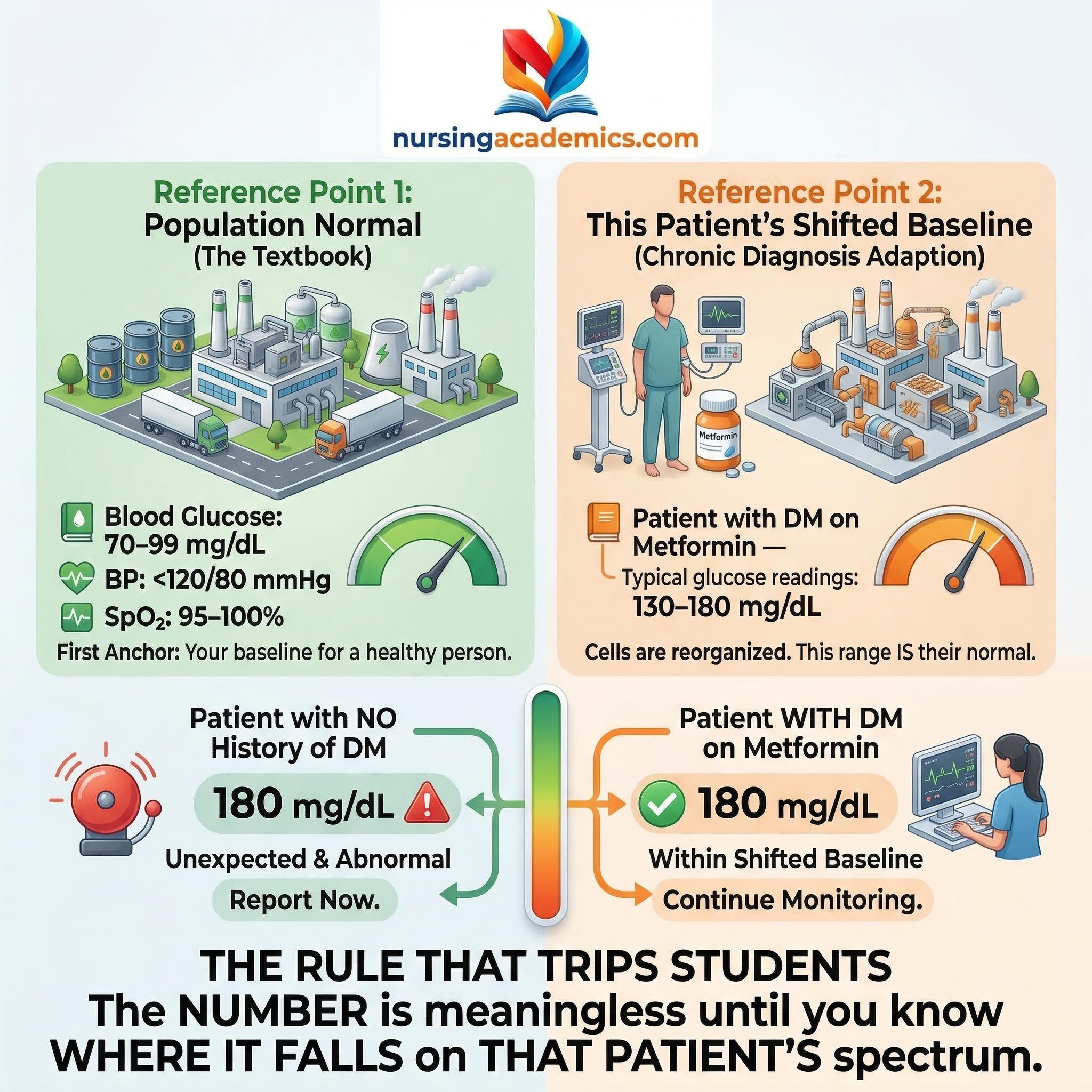
A Cue Is Any Patient Data: The Baseline Mistake That Makes Students Miss Questions
One of the most common reasoning mistakes in nursing education is the belief that only abnormal findings count as cues. Students read a question, see a value that matches the patient's history, and mentally dismiss it. That is a problem. A cue is any patient data. The issue is not whether it counts. The issue is what it means in this patient.
Baseline matters, but not in the way many students think. Baseline does not decide whether a finding is a cue. Baseline helps you interpret the cue. A chronic low oxygen saturation is still a cue. A known neurological deficit is still a cue. A patient's usual edema pattern is still a cue. Those findings may be expected, but they remain part of the data set.
Why this mistake matters so much
When students dismiss expected data too early, they lose context. Then when a truly dangerous finding appears, they may not understand what makes it dangerous. The baseline creates the reference frame. Without that frame, the learner cannot tell what is stable, what is worsening, and what is truly new.
That is why baseline is one of the fastest ways to improve clinical judgment. It sharpens interpretation before prioritization even begins.
How this shows up on exams
Imagine two patients with shortness of breath. In one patient, this is a longstanding chronic pattern. In the other, it is a sudden new change. The symptom may be the same, but the meaning is not. If the student ignores baseline, both patients look equally alarming or equally routine. That leads to unsafe answers.
NCLEX-style questions often test this exact skill. They want to know whether the learner can compare the current cue to the patient's usual state. The test is not only about identifying a symptom. It is about interpreting that symptom in context.
What good baseline building actually includes
A strong baseline includes the diagnosis, chronic findings, recent procedure or treatment context, medication profile, normal pattern for that patient, and what the patient looked like earlier. It also includes the trend. A stable mild abnormality and a worsening abnormality are not the same clinical situation.
Once the learner builds that picture, they can sort findings into expected, new, worsening, or dangerous. That makes the next action much clearer.
Why this is especially important for LPN thinking
LPN practice depends heavily on safe recognition, monitoring, documentation, and reporting. That means the learner must be strong at seeing change against baseline. It is not enough to know what a lab value "normally" is in the abstract. The student must know whether this patient is now moving away from their expected pattern.
That is why baseline building is not a minor step. It is a safety step.
How NursingAcademics teaches this
The platform does not treat baseline as a side note. It is built into the tutorials, the question strategy, and the pre-exam immersion sequence because students cannot interpret cues safely without it.
Practice baseline building