
Delegation, Scope, and Safety: The Part Students Memorize but Still Miss
Students often approach delegation questions by trying to memorize who can do what. That matters, but it is not enough. The better question is: what part of this situation requires judgment, interpretation, or close monitoring for change? Once the learner starts there, delegation becomes much clearer.
Delegation is not only about task assignment. It is about patient stability and risk.
Why memorized role rules break down
A task that is safe for one patient may not be safe for another. Taking routine vital signs on a stable patient is not the same as taking vital signs on a patient who is newly unstable, deteriorating, or showing subtle compensation failure. The task may look similar, but the level of required judgment is different.
That is why learners who rely only on job-title memorization still miss delegation questions. They are ignoring the patient context.
What makes an answer safer
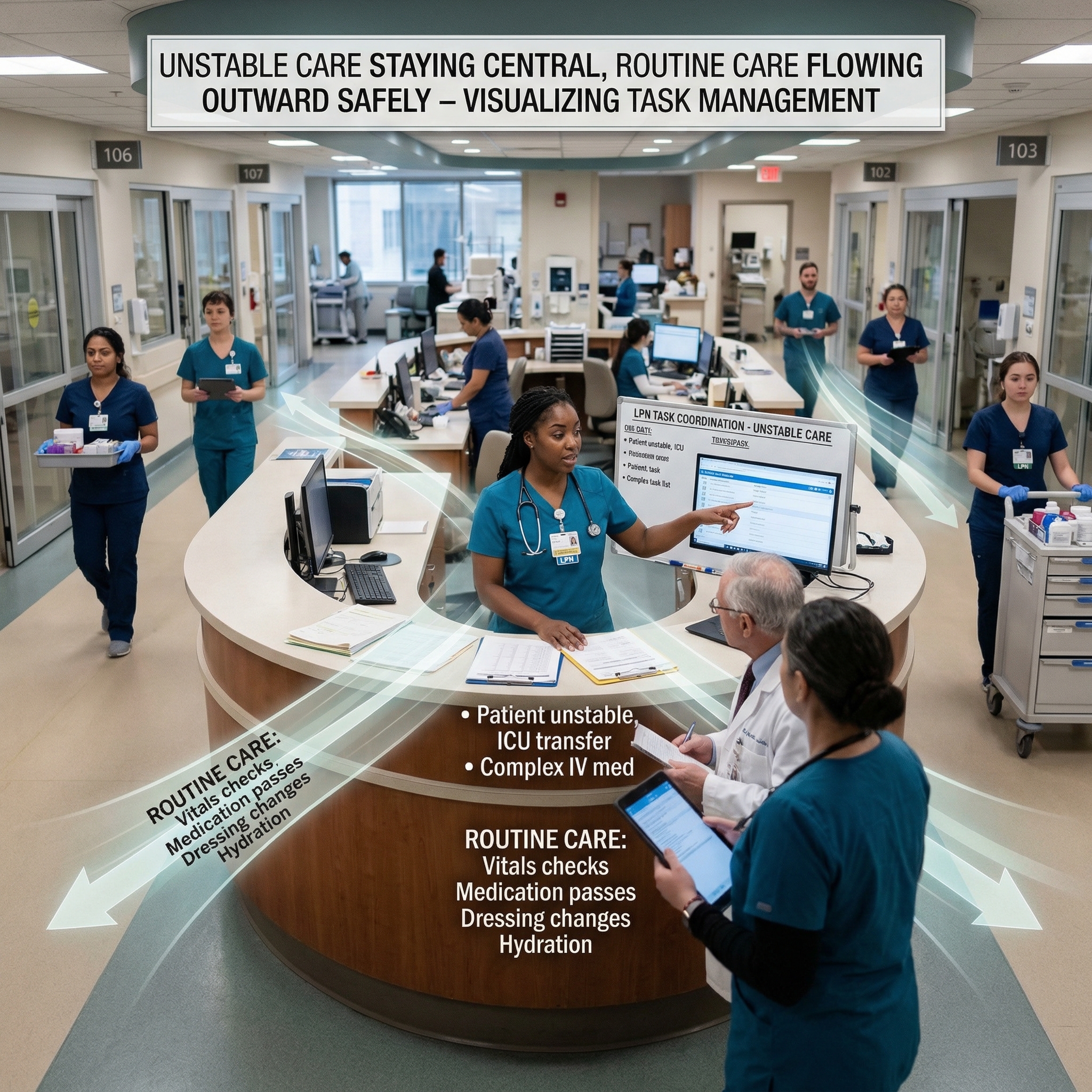
The safer answer usually keeps judgment-heavy care with the licensed nurse and delegates routine, predictable, low-risk work appropriately. Anything involving new instability, interpretation, initial teaching, or high risk should raise caution immediately.
This is especially important for LPN learners, because safe practice includes knowing when to monitor, when to reinforce, when to carry out expected care, and when to report promptly.
Why safety sits underneath delegation
The point of delegation is not efficiency by itself. The point is safe care. That means the learner should ask: could this patient deteriorate quickly? Does this situation require nursing judgment? Is there a change from baseline? If yes, delegation should be approached more carefully.
Once students understand this, delegation questions stop feeling like legal trivia and start feeling like clinical reasoning.
How the program teaches delegation
NursingAcademics frames delegation inside patient stability, scope, and safety so learners can reason through these questions instead of guessing from memorized fragments.
Train safer delegation decisions