
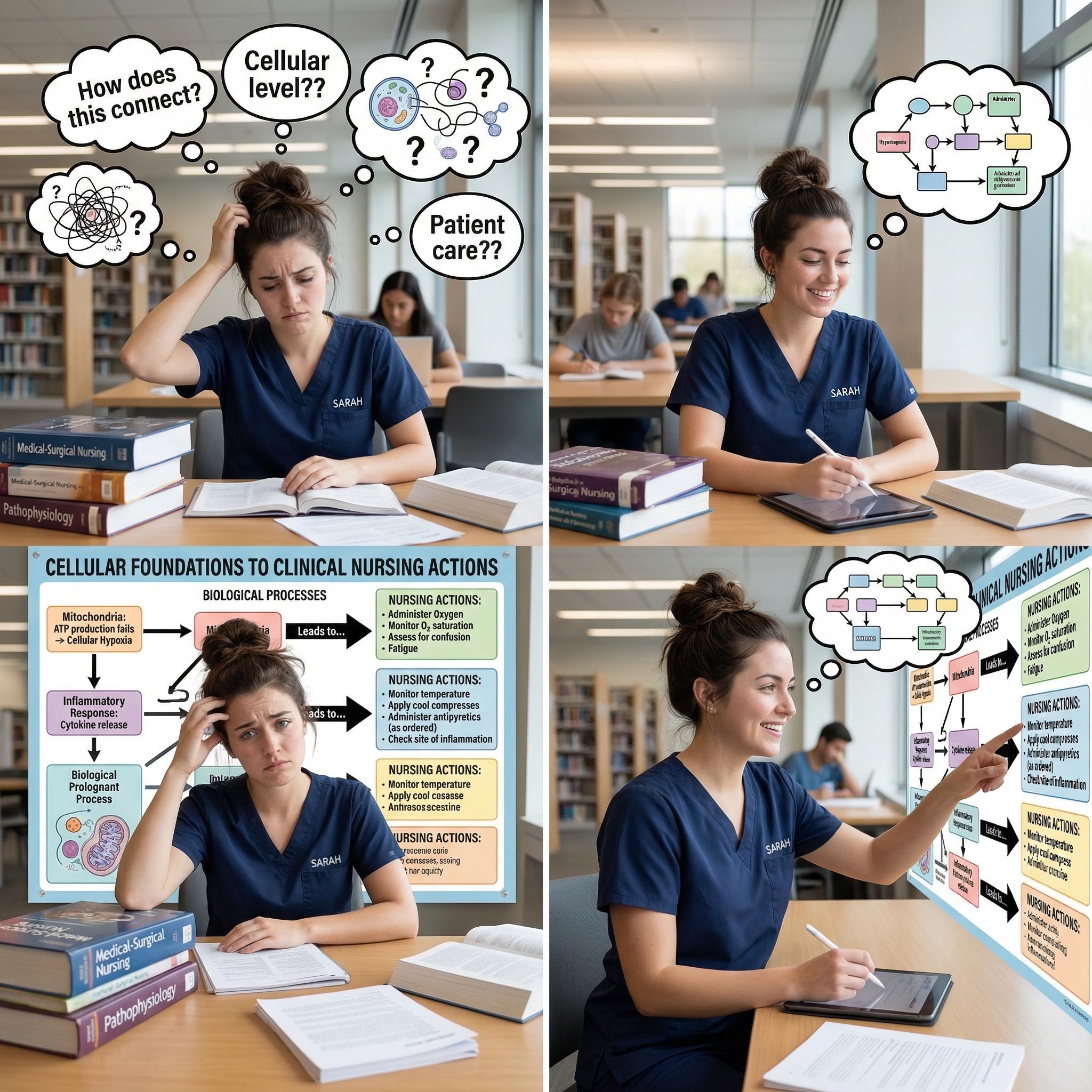
How to Build Clinical Judgment When Your A&P Foundation Is Weak
Many students quietly believe that weak A&P means they are permanently behind. They think everyone else understands the body in some deep intuitive way that they missed years ago. That belief is painful, and it often leads to panic studying. But the truth is simpler: weak A&P becomes dangerous only when it remains disconnected from clinical meaning.
Students do not need endless biology detail first. They need the right biological ideas in the right order, tied directly to patient change. When that happens, clinical judgment can begin to build even if the learner's starting point is low.
What students with weak A&P actually need
They need to understand perfusion, the cell as a factory, supply failure, compensation, and return to baseline. Those concepts create a scaffold. Once the scaffold exists, membranes, receptors, tissues, fluids, electrolytes, and organ systems start fitting into something real.
Without that scaffold, the learner is just gathering vocabulary. With it, the learner is building reasoning.
Why the usual approach fails many learners
Traditional review materials often assume the learner already sees the links between physiology and nursing action. That assumption leaves weaker students stranded. They read a chapter, recognize some terms, and still do not know how those terms help them answer a question about confusion, low blood pressure, bleeding, or respiratory distress.
The fix is not merely "make it simpler." The fix is to make it coherent.
How judgment grows from the foundation
Once the learner understands that cells need supply before they can function, many topics become easier to organize. If oxygen delivery drops, what fails first? If electrolytes shift, what tissues show it? If inflammation becomes excessive, what happens to perfusion? If medication changes one part of the process, what patient cues should improve or worsen?
That is the start of clinical judgment. It grows from a biologic pattern, not from memorized noise.
Why this matters for NursingAcademics
The program was designed for students who feel behind. Phase 1 does not assume deep prior mastery. It rebuilds the needed biology in a way that directly supports later systems and exam reasoning.
Rebuild your Phase 1 foundation