
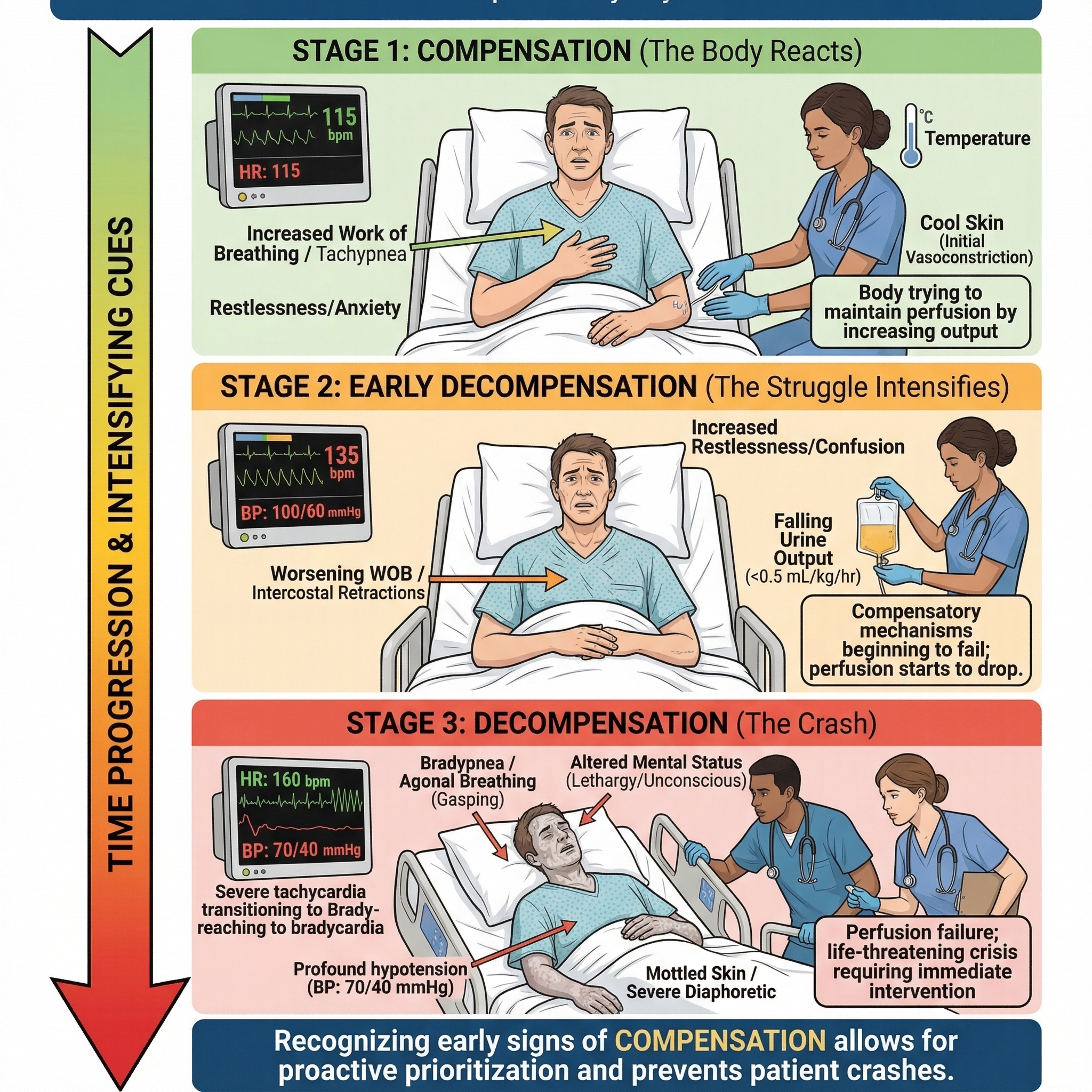
The Compensation Ladder: How the Body Warns You Before Collapse
Patients rarely collapse without warning. The body usually tries to compensate first. Heart rate rises. Respiratory effort changes. Skin cools. Urine output falls. Mental status shifts. These findings can look subtle when seen separately, but together they often signal that the body is working hard to preserve perfusion.
That is why prioritization is not just about spotting disaster. It is about recognizing compensation early enough to understand where the patient is heading.
Why compensation is easy to miss
Compensation can create the illusion of stability. A patient may still be awake, still speaking, or still within a technically acceptable blood pressure range. The student sees that and relaxes. But the body may already be climbing the compensation ladder. If the underlying problem is not corrected, the next step is not stability. It is failure of compensation.
This is why a resting heart rate of 120, new restlessness, cool skin, or increasing work of breathing should never be treated as random details.
How the ladder helps prioritize
Once the learner understands compensation, many questions become clearer. The correct answer often protects the patient before collapse occurs. The unsafe answer is often the one that waits for the obvious crash. That is why compensation belongs near the front of the reasoning process, especially in first-action and who-do-you-see-first questions.
Seeing compensation also helps with expected-versus-unexpected cue sorting. A finding may still be "within range" on paper and still be clinically concerning when viewed as part of a larger compensation pattern.
How this ties back to perfusion
The compensation ladder matters because perfusion is trying to be protected. The body raises heart rate, changes breathing, shifts vascular tone, and adjusts function because tissue supply is threatened. If the student sees only the symptom and not the reason behind it, they will miss the meaning.
That is why the compensation ladder and perfusion-first thinking belong together.
How this is trained in the program
NursingAcademics teaches compensation as a repeated pattern across systems, not as a one-off concept. That helps students recognize danger earlier and prioritize more safely.
Practice compensation-based prioritization