
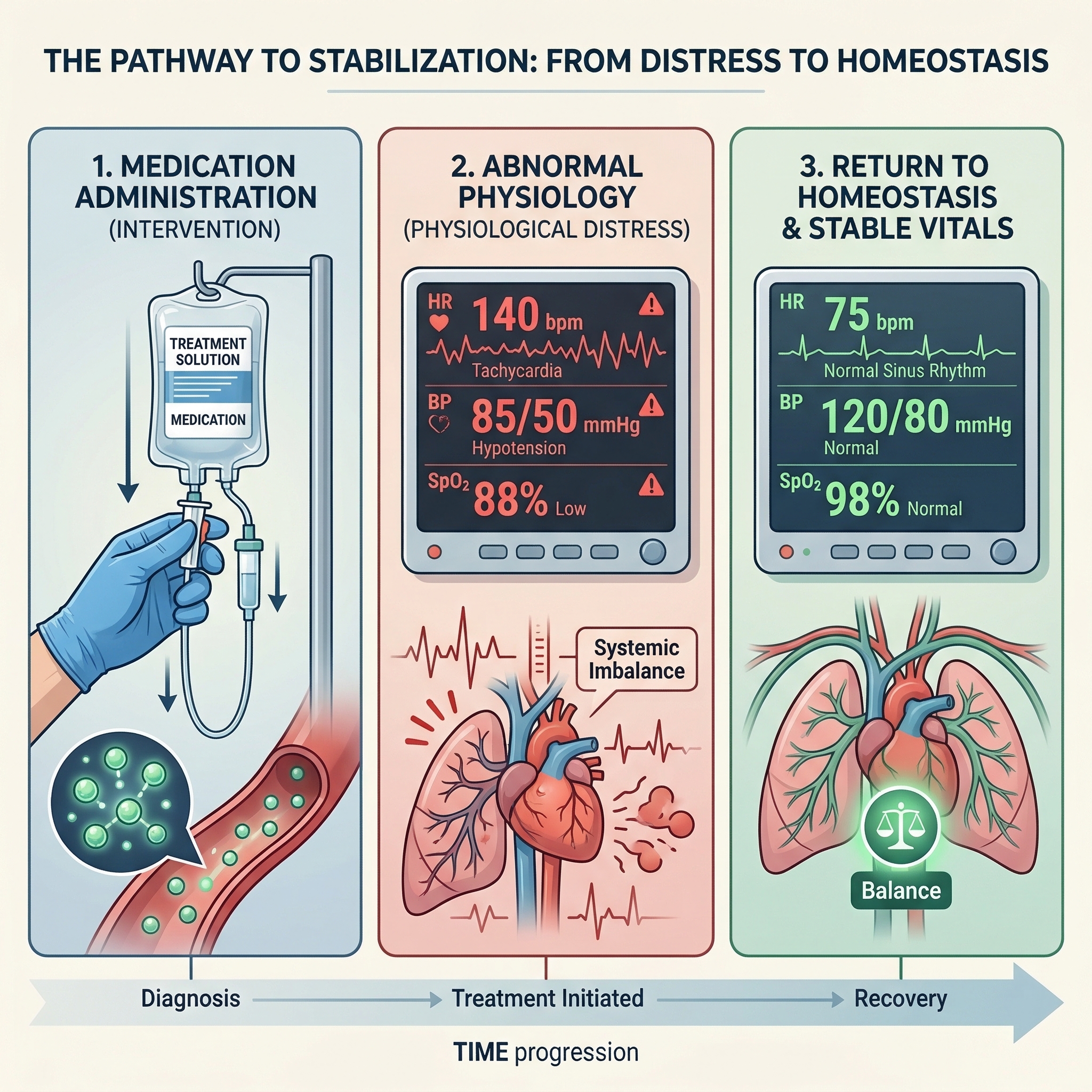
The Hidden Rule Behind Almost Every NCLEX-PN Question: Perfusion First
Many students believe NCLEX questions are random. One question looks respiratory, the next looks renal, the next sounds neurological, and the student feels like they are being asked to jump between unrelated worlds. But beneath many of those questions sits the same hidden rule: can you recognize when tissue supply is threatened?
Perfusion is not just "a cardiovascular topic." Perfusion is the delivery of oxygen, fluids, glucose, electrolytes, nutrients, and circulating support to living tissue. If perfusion drops, cell function drops. When cell function drops long enough, organs begin to fail. That is why perfusion sits under far more questions than students usually realize.
Why perfusion comes before organ labels
Students often start by trying to identify the disease label. That can help, but it is not always the safest first move. A better question is: are the cells still being supplied? If the answer is no, the surface topic matters less than the supply problem beneath it. Shortness of breath, confusion, low urine output, cool extremities, weak pulses, and restlessness all begin to make more sense when the learner sees them as signs of threatened delivery.
This is why airway, breathing, circulation, and perfusion are so tightly linked. Air is useful only if oxygen reaches the blood. Blood is useful only if circulation reaches tissue. Tissue is stable only if cells receive what they need. The organ system may change, but the priority logic does not.
How this changes question strategy
When a student reads a question through the perfusion lens, the noise level drops. Instead of chasing every detail equally, the learner asks: Which finding suggests oxygenation is failing? Which cue suggests circulation is not reaching tissue? Which action protects delivery first? That does not replace disease knowledge. It organizes it.
For example, in one question the patient may be pale and tachycardic after surgery. In another, the patient may be confused with low oxygen saturation. In another, the patient may have low urine output and weak pulses. Those questions may look different on the surface, but all of them require the learner to respect threatened perfusion.
Why students miss this rule
Most students are taught diseases and medications before they are taught the supply logic beneath them. They know the vocabulary, but not the order of reasoning. So they often answer questions by chasing familiar words instead of by tracing what is happening to the patient. That is why their answers can feel uncertain even when they studied the content.
Once perfusion becomes the first filter, the learner gains a safety anchor. They can look at a stem and quickly ask whether the problem threatens oxygenation, circulation, or downstream tissue function. That makes prioritization less mysterious.
The practical value of this shift
Perfusion-first thinking does not make every question easy. It does make many questions less chaotic. It tells the learner what to check first, what to fear most, and which answers are likely too delayed, too superficial, or too disconnected from the real risk.
The student who sees perfusion clearly stops feeling like the exam is a random collection of traps. They begin to notice the repeated pattern underneath the test.
What the program does with this idea
NursingAcademics teaches perfusion as the base layer under Phase 1, systems pathways, and pre-exam immersion. That means learners do not just hear "perfusion matters." They practice seeing it before they answer.
Start learning perfusion first