
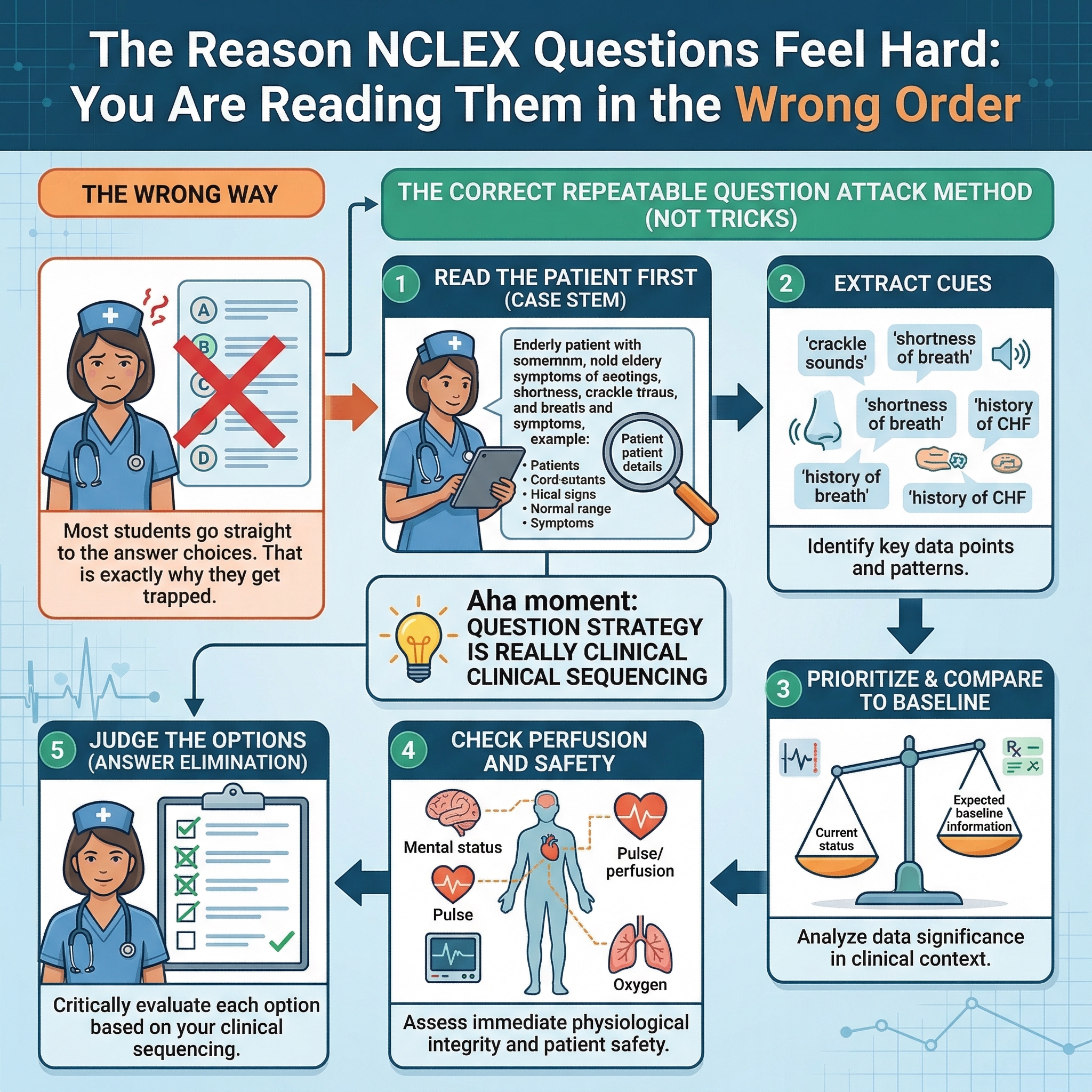
The Reason NCLEX Questions Feel Hard: You Are Reading Them in the Wrong Order
One of the fastest ways to make an NCLEX question feel impossible is to look at the answer choices too early. Many students do this without realizing it. They glance at the stem, see a familiar word, rush to the options, and then start reacting to whichever choice sounds most recognizable. That reading order creates confusion because the patient has not been interpreted yet.
The patient must come before the options. Otherwise the answers start controlling the learner's thinking instead of the data controlling the learner's thinking.
What the better reading order looks like
First, read the patient situation. Second, pull the cues. Third, compare those cues to baseline and expected findings. Fourth, check perfusion, safety, and urgency. Only after that should the answer choices be judged. That order makes the options easier to eliminate because the learner now has a clinical frame.
Without that frame, all four answers can feel plausible. With that frame, one answer often begins to look more protective, while another starts to feel delayed, unsafe, or focused on the wrong problem.
Why familiar answers can be dangerous
Students are often pulled toward the most familiar action. If they have memorized a disease or medication word before, they may anchor to it too quickly. That is how they miss the real priority. The best answer is not the one that sounds most familiar. It is the one that best protects the patient described in the stem.
This is especially important in prioritization and first-action questions. The stem gives the meaning. The options only make sense after the meaning is clear.
How this changes exam confidence
Students who learn to slow down at the right moment actually feel faster over time. They stop being pulled in four directions at once. Their minds settle because they know what they are doing first: read the patient, not the temptation.
That is why question attack strategy should be taught as clinical sequencing, not as a list of tricks.
What the program teaches
NursingAcademics trains learners to read the patient before the answer choices, to compare cues to baseline, and to use one repeated decision path instead of guessing from familiarity.
Train the question-attack method