
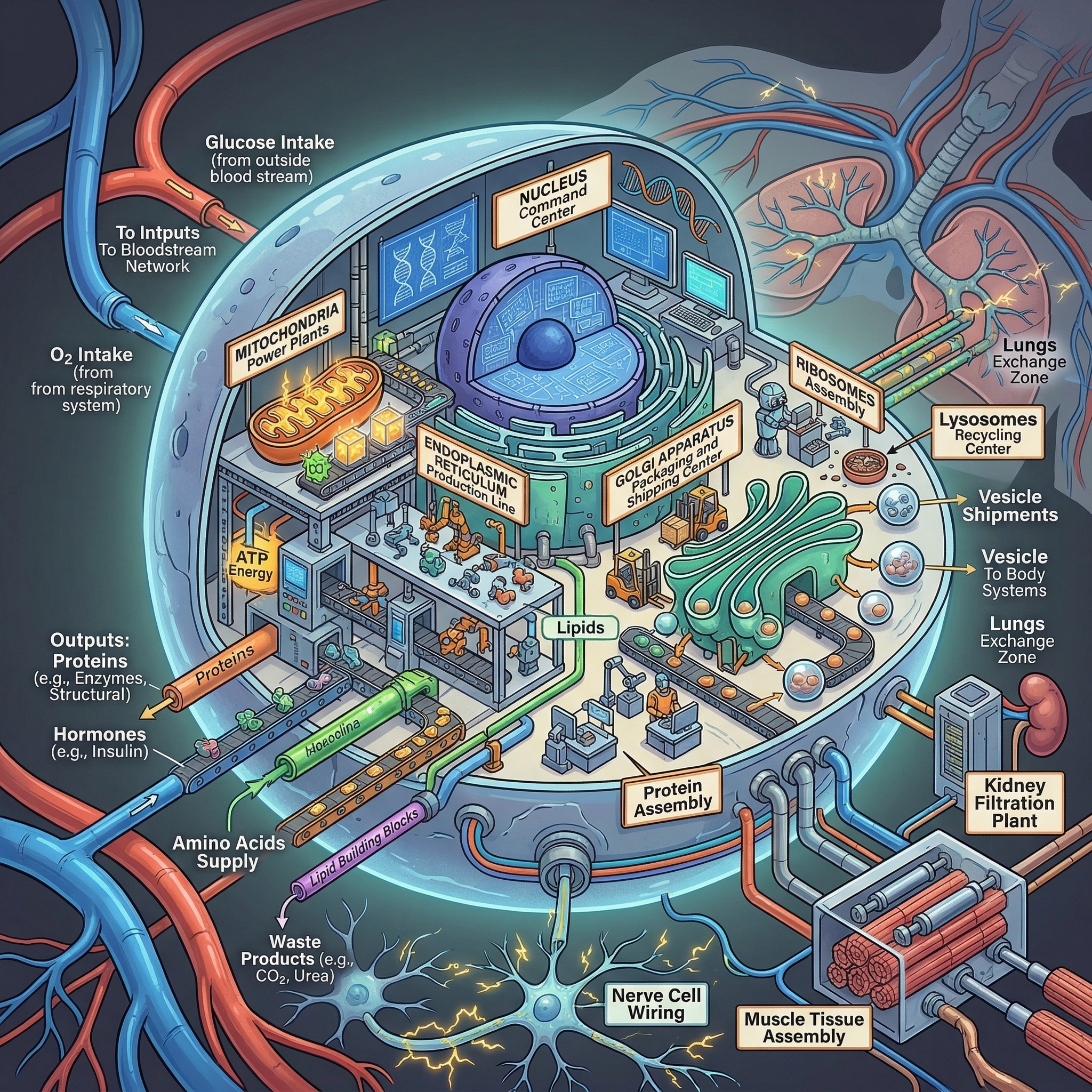
Why the Cell Factory Method Changes Everything
Most nursing students are handed content in pieces. There is a chapter on membranes, another on tissues, another on heart failure, another on renal problems, another on endocrine disorders, and then eventually another on medications. The learner is expected to somehow assemble those parts into clinical judgment on their own. That is where many students get stuck.
The Cell Factory Method changes that by giving the student one structure that works across the whole library. Every cell needs inputs. Every cell has machinery. Every cell produces outputs. When inputs fail or machinery is damaged, the output changes. Those output failures then show up as system-level patient cues.
Why one repeated pattern matters so much
The real power of the method is repetition without randomness. The organ system may change, but the logic remains the same. In cardiac topics, you still ask what supply problem or machinery problem is present. In renal topics, you still ask what inputs or outputs are failing. In pharmacology, you ask how the medication moves the patient back toward baseline by correcting the disrupted factory process.
This means the student is not learning a hundred unrelated rules. They are learning one reasoning engine and then practicing it in different clinical settings. That is much easier to retrieve under pressure than a pile of isolated memorized points.
How the method improves clinical judgment
Clinical judgment depends on pattern recognition. If a learner can see that the patient's cells are not being supplied, or that the machinery inside the system is being blocked, then symptoms make more sense. The student stops memorizing "signs of disease" as a list and starts understanding why those signs appear.
That is a huge shift. Confusion decreases because the learner is no longer staring at random clues. They are tracing a process. That process helps with recognizing cues, analyzing cues, prioritizing hypotheses, generating solutions, and choosing safer actions.
Why this is different from ordinary simplification
Some teaching methods simplify by stripping away detail. That can feel easier at first, but it often fails when the student reaches more complex cases. The Cell Factory Method is different. It does not flatten the science. It organizes the science. The biology stays real, but the learner finally sees how it drives the nursing picture.
That matters for near-zero-foundation students. They need clarity without distortion. They need physiology translated into patient meaning, not just reduced into slogans.
Why this matters for the program
NursingAcademics is built around the Cell Factory Method from Phase 1 through Phase 3. The student does not have to rebuild their reasoning style every time the topic changes. The method stays with them the whole way.
See the Cell Factory Method in action