
Why Your Notes Are Not Helping You
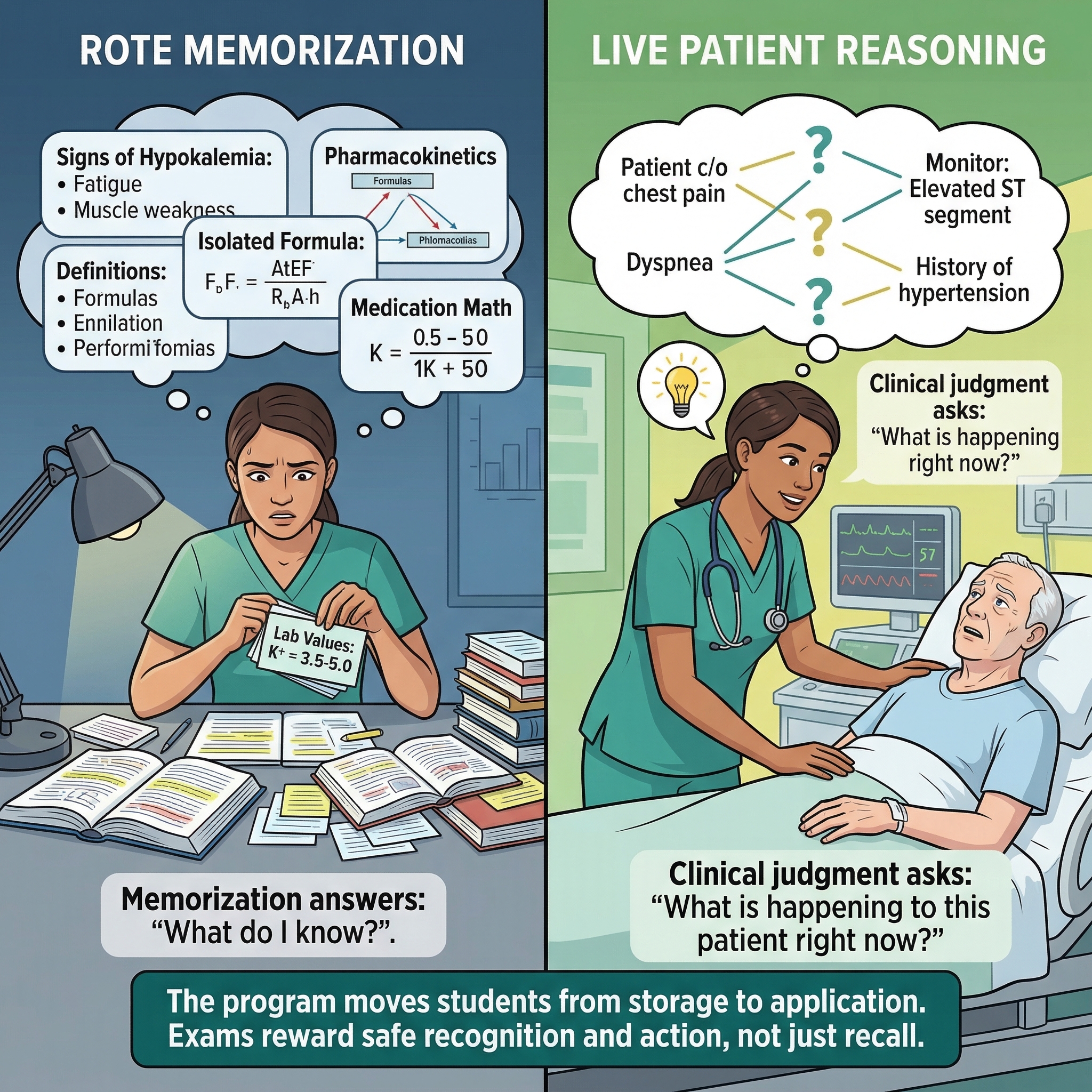
Many nursing students have beautiful notes and weak recall under pressure. That is not because note-taking is bad. It is because many notes preserve facts without preserving logic. The student can reread pages of content and still not know what to do when a patient scenario appears.
Good notes should do more than record information. They should protect the reasoning path.
Why ordinary notes fail
A typical page of notes may contain symptoms, causes, medications, and side effects. But when the student later opens that page, it still does not answer the most urgent questions: what is happening first, what is most dangerous, what cues matter most, and what action protects the patient now? That is why notes can look thorough and still feel useless during question practice.
If the note does not preserve clinical relationships, it becomes storage, not strategy.
What stronger notes should capture
At minimum, students need a way to record supply failure, the affected cell or system, the body's compensation, the most important cues, and the protective nursing move. That is much more powerful than writing down every isolated fact the student sees on a slide.
When notes are built around patterns, review becomes much faster because the student is revisiting meaning, not just rereading words.
Why the wrong note system increases overwhelm
Overwhelmed students often create more notes when they feel lost. That seems productive, but it can make the pile even heavier. If each page is another unstructured list, the learner ends up with a larger mountain and the same confusion.
The better solution is fewer notes with stronger structure.
What the platform gives instead
NursingAcademics gives students a reusable framework so their learning is organized around perfusion, baseline, cues, and action. That makes both studying and review far more efficient.
Study with structure instead